Think back to your very first day as a recruiter in a new job.
You sat down at your desk with a blend of (what you thought were) baseline skills, nerves, and genuine enthusiasm. But, by the end of the day, you realized that your new colleague’s internal jargon is a whole new language you’ll need to learn ASAP, you couldn’t recall where they told you past records were stored, and you certainly had no idea who the company already interviewed last quarter. The result: you had to spend your first few weeks digging through old records, asking colleagues where things lived, and making sense of scattered notes just to get up to speed.
For years, that is exactly how we have treated artificial intelligence in recruitment. We give an AI tool a prompt, treat it like a day-one employee who lacks institutional memory, and expect it to magically know our business. We expect output without giving it context.
Loxo’s new Longlist Agent changes that paradigm. Instead of us sending an AI out into the wilderness (AKA the world wide web) with zero context, we have our Longlist Agent start its very first day on the job with full access to your firm’s entire history. Here is why that distinction changes everything for your front-of-funnel recruiting process…
What is the reality of today’s recruiting market?
As a modern recruiter, you're juggling more requisitions with fewer resources, while fragmented candidate data makes every search harder.
Let’s lay it all out on the table: recruiting teams are squeezed tighter than ever. And that’s not just a talking point — it's backed up by hard data:
The Gem 2026 Recruiting Benchmarks Report found that the average recruiter now manages 13.4 open requisitions at once (a 40% increase since 2021) even as talent acquisition teams have shrunk by 14%.
At the same time, sourcing has become a fragmented treasure hunt. Whether you call it a longlist, a pipeline, a slate, a bench, or a hotlist, building that initial candidate pool requires jumping between public websites, CRM records, spreadsheets, and scattered email threads.
Worst of all, data shows that nearly half (46%) of all sourced hires come from candidates a company already knows — up from 26% in 2021. Yet, because that institutional memory sits buried in stale CRM notes, recruiters waste hours re-discovering candidates they’ve already placed, interviewed, or spoken with.
What are you risking by keeping your sourcing the same?
When you build lists manually, you spend valuable recruiter hours on admin, miss candidate overlap, and struggle to maintain consistent market coverage across your desk.
Every candidate list you build by hand adds friction today, and operational risk tomorrow:
- You waste capacity on low-leverage work: On large in-house teams, dedicated sourcers can handle at least 70% of the heavy lifting before a recruiter ever conducts a screen. When you do this work by hand, you turn your highest-paid talent into data-entry clerks.
- You pay the “re-discovery” tax: When you search external platforms first, you risk overlooking candidates already sitting in your own database. You end up spending time and money re-acquiring relationships you already own.
- You create inconsistent output: When you build candidate pools the “old way,” results depend on who builds the list and how much time they have. A search you start on a tired Friday afternoon — or hand to a junior researcher in week three — won’t deliver the same market coverage as one led by a veteran partner.
And the impact goes beyond saving recruiter hours. With better visibility and confidence in execution, you could start taking on larger, more complex searches — just as Emerald Resource Group did, expanding into senior leadership roles and retained engagements.
Read the Emerald Resource Group customer story to see how they cut time-to-fill by seven days with Loxo → Read the Emerald Resource Group customer story
How much time do you spend building candidate lists instead of evaluating talent?
Sourcing still looks a lot like a manual, multi-tab assembly process. At the start of a search, recruiters jump between databases, ATS/CRMs, spreadsheets, and profile pages — spending valuable time moving data around instead of evaluating the people behind it.
Your process can often looks something like this:
- Start with the requisition: Review the intake notes and define the search.
- Search external databases: Run keyword searches across external networks and talent platforms.
- Check the internal database: Cross-reference candidates against the ATS/CRM to uncover existing relationships and avoid duplicating work.
- Build the candidate list: Copy and paste profile links into a Word document, spreadsheet, or PDF.
- Work around platform limits: Hit daily import caps or export walls and find manual ways to keep the search moving.
AI is already changing other parts of talent acquisition. 89% of HR professionals whose organisations use AI to support recruiting say it saves them time or increases their efficiency, according to SHRM’s 2025 Talent Trends research. Yet AI adoption is not evenly distributed across the recruitment funnel. SHRM found that 44% of organisations using AI for recruiting apply it to resume screening, compared with 32% using it to automate candidate searches.
And even where AI enters the sourcing workflow, the experience often remains fragmented. Most tools return a simple “match score” against only part of their database, rather than giving recruiters a comprehensive view of the available market.
The result: sourcing still depends heavily on manual research, fragmented data, and the recruiter's ability to piece it all together.
What is the Longlist Agent and how can you break through the sourcing bottleneck?
The Longlist Agent works alongside you to search Loxo’s 850M+ talent graph and your firm’s private database, building a candidate pool of up to 10,000 people in minutes.
Instead of choosing between your own database and the external market, you can search both at the same time.
The Agent goes beyond simple keyword matching or a black-box top-10 list. It draws on your firm’s entire recruiting history — including past conversations, notes, activities, and emails — and combines it with Loxo’s continuously refreshed talent graph of 850+ million profiles.
Here’s what changes for your day-to-day:
- Search your own and external data together: Surface people your firm already knows alongside new prospects, without switching between systems or manually cross-referencing records.
- See the full market: Build deep pools of up to 10,000 candidates, giving you the coverage to evaluate the market without import caps or arbitrary limits.
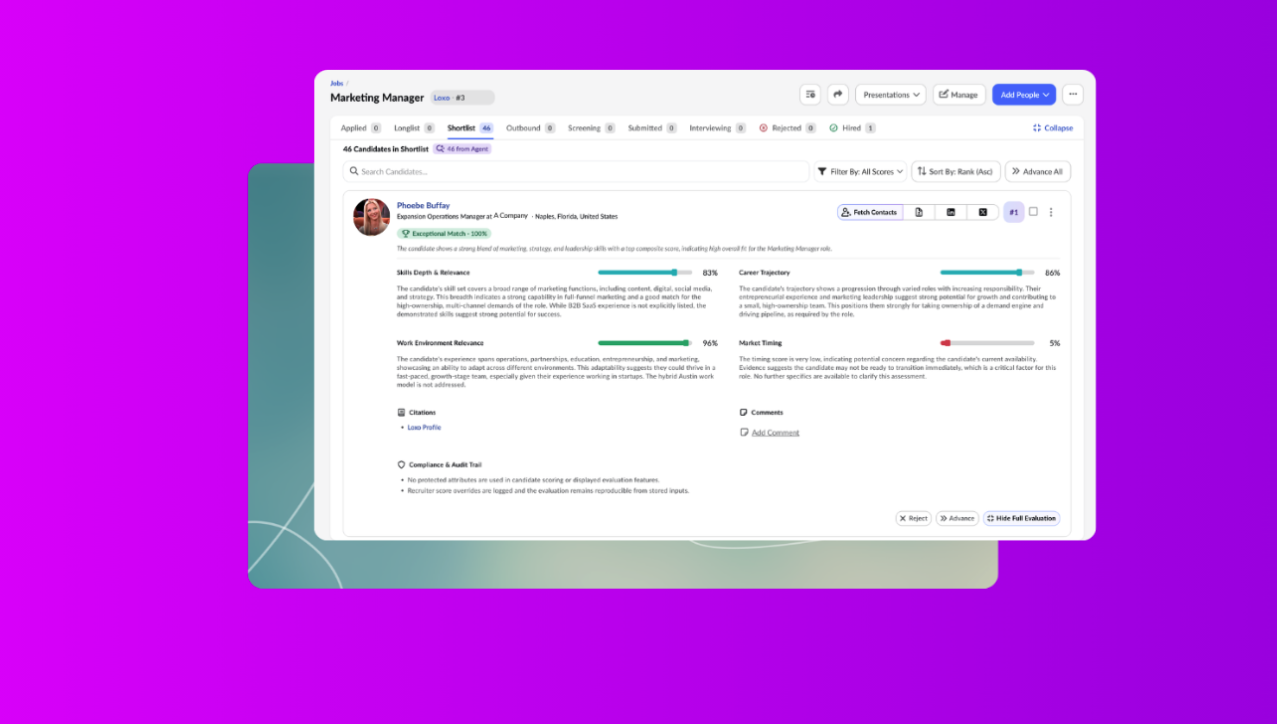
- Stay in control of the search: Use Loxo’s interface, including “the dial,” to decide how much work to delegate. The Agent builds the pool; you review the results, decide who moves forward, and choose what happens next.
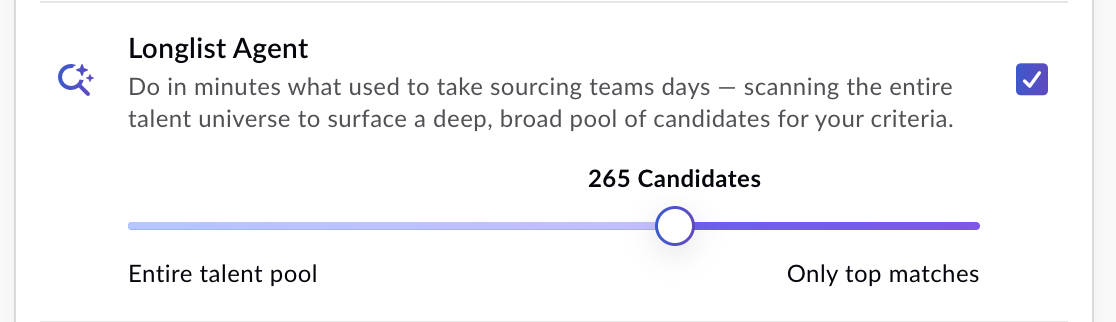
Why should you care about agentic longlisting?
Agentic longlisting changes what your team can accomplish with the same recruiting resources. The Longlist Agent removes the manual work involved in building candidate pools, unlocks more value from your existing database, and gives recruiters more time to focus on the work that drives searches forward.
→ See how the Longlist Agent builds a 10,000+ candidate pool in under 5 minutes. Book a demo.
Here is how this can translate to tangible results across your organization:
.jpg)
How does the Longlist Agent fit into the larger Agent Workforce?
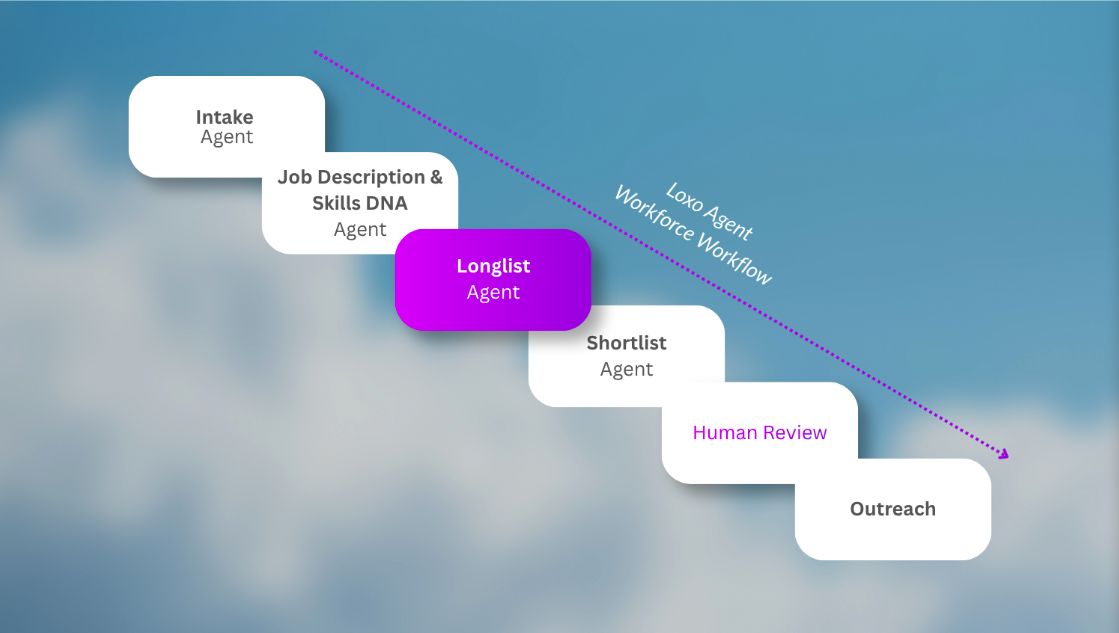
The Longlist Agent connects Loxo’s end-to-end Agent Workforce, turning your intake context into a comprehensive candidate pool before you make your shortlist.
Great AI isn’t about isolated point solutions or “bots” that spam candidates. It’s about giving you structured, end-to-end support while keeping human judgment at the centre of every search.
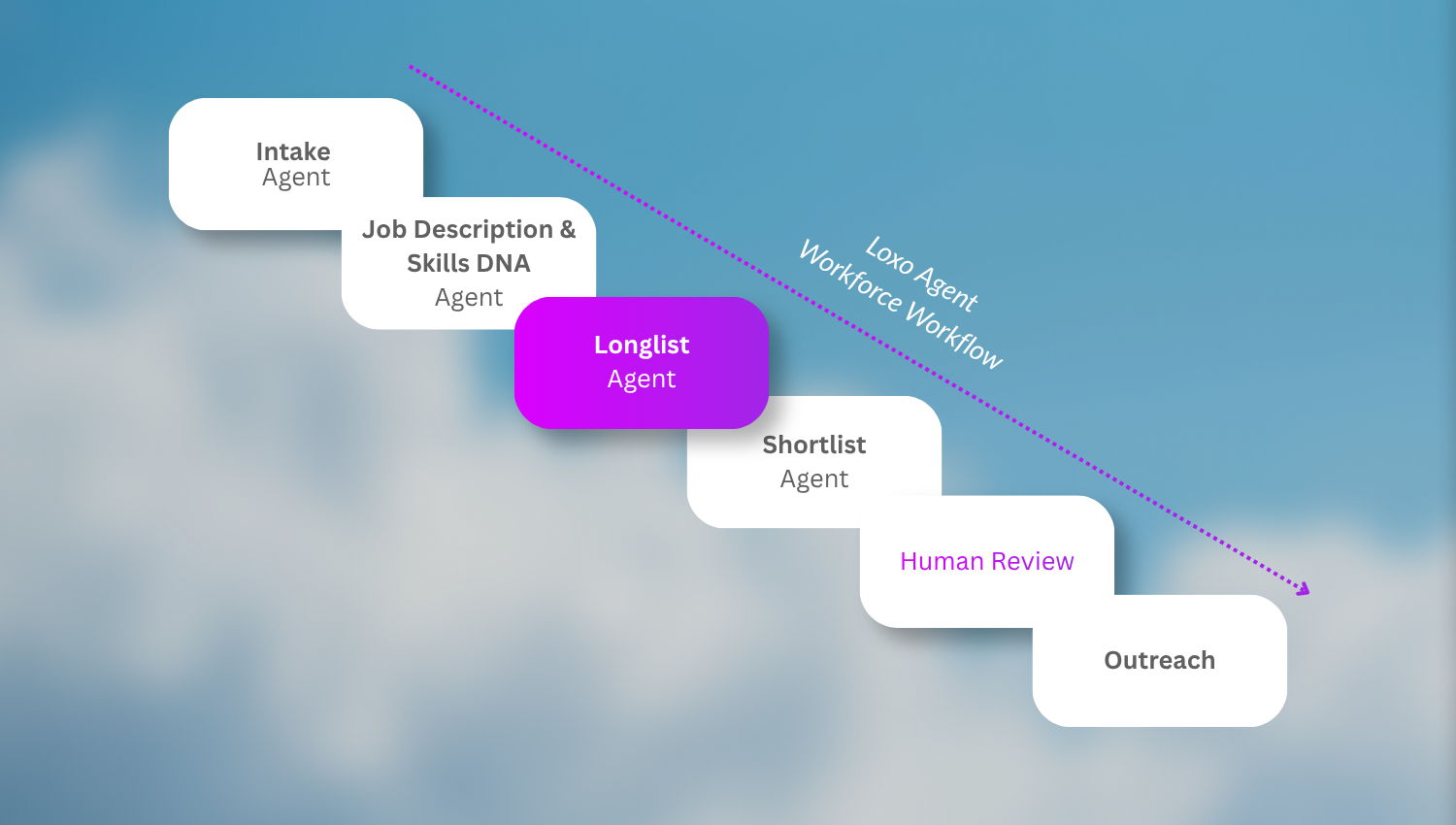
How you move from intake to outreach
Within Loxo’s Next Generation release, each agent takes on a specialized part of your workflow:
- Intake Agent: Capture role requirements, business context, and ideal candidate criteria directly from hiring manager conversations.
- JD & Skills DNA Agent: Translate unstructured intake notes into dynamic role intelligence — mapping core competencies, weighting must-have skills, and defining the exact candidate criteria before writing the job description.
- Longlist Agent: Use that intake context and Skills DNA to scan the market and your CRM, building the entire addressable candidate pool of up to 10,000 candidates.
- Shortlist Agent: Narrow the pool down to the most relevant matches based on your search criteria and weighted role data.
- Human Review: Review the pool, validate your strategy, and make the final decisions.
- Outreach: Initiate hyper-personalized, multi-channel engagement with top candidates.
You set the strategy. The agents handle the labor.
By connecting these specialized steps, Loxo helps you move from intake to a qualified candidate pool without losing control of the search. The Longlist Agent handles the heavy lifting, while you retain ownership of the decisions that matter.
No candidate gets contacted automatically, and no decision-making gets outsourced. You stay in control of the search from first intake to final outreach.
How do we wrap this all together?
Recruiting hasn't changed because people stopped valuing human connections — it got bogged down because the administrative weight of finding candidates outgrew the hours in a day.
When you onboard a human employee, you don't keep them isolated from your company's past work and expect them to excel. You give them access to your systems, teach them your history, and give them the tools to succeed. The Longlist Agent operates on that exact same philosophy. It isn't an "out-of-this-world" novelty or a hands-free bot designed to replace your desk. It is an AI teammate that arrives on day one already knowing your company’s history, ready to do the heavy lifting so you can focus on the conversation.
There’s no need for you to keep starting every candidate search from scratch. Let the Longlist Agent build the pool, so you can spend your time placing the talent.
→ Ready to see how Loxo's Agent Workforce can transform your talent pipeline? Explore the Longlist Agent today.
<script type="application/ld+json">
{
"@context": "https://schema.org",
"@graph": [
{
"@type": "BlogPosting",
"@id": "https://www.loxo.co/blog/why-your-initial-candidate-pool-is-your-biggest-bottleneck-when-recruiting-and-how-to-fix-it#article",
"headline": "Why Your Initial Candidate Pool Is Your Biggest Bottleneck When Recruiting...and How To Fix It",
"description": "Explore Loxo's Longlist Agent to automate candidate sourcing, search your CRM and 850M+ profiles, and build comprehensive candidate pools in minutes.",
"url": "https://www.loxo.co/blog/why-your-initial-candidate-pool-is-your-biggest-bottleneck-when-recruiting-and-how-to-fix-it",
"mainEntityOfPage": { "@type": "WebPage", "@id": "https://www.loxo.co/blog/why-your-initial-candidate-pool-is-your-biggest-bottleneck-when-recruiting-and-how-to-fix-it" },
"datePublished": "[PUBLISH-DATE]",
"dateModified": "[MODIFIED-DATE]",
"inLanguage": "en-US",
"author": { "@type": "Organization", "name": "Loxo", "url": "https://www.loxo.co" },
"publisher": {
"@type": "Organization",
"name": "Loxo",
"url": "https://www.loxo.co",
"logo": { "@type": "ImageObject", "url": "https://cdn.prod.website-files.com/663b70d752cc952b743d3b67/66bd257bbdba631be076b2e4_loxo-logo.svg" }
},
"image": { "@type": "ImageObject", "url": "https://cdn.prod.website-files.com/665f887083756c794a9927dd/6ac40b18faf974e658a04312_longlist%20agent.png" },
"articleSection": "Artificial Intelligence",
"keywords": "candidate pool, candidate longlist, candidate sourcing, sourcing automation, recruiting CRM, talent graph, AI agents for recruiting",
"about": [
{ "@type": "Thing", "name": "Candidate sourcing" },
{ "@type": "Thing", "name": "Candidate pool" },
{ "@type": "Thing", "name": "Recruitment" }
],
"mentions": [
{
"@type": "SoftwareApplication",
"name": "Loxo Longlist Agent",
"applicationCategory": "BusinessApplication",
"url": "https://www.loxo.co/ai-agents/sourcing-agents"
},
{
"@type": "SoftwareApplication",
"name": "Loxo Shortlist Agent",
"applicationCategory": "BusinessApplication",
"url": "https://www.loxo.co/ai-agents/sourcing-agents"
},
{
"@type": "SoftwareApplication",
"name": "Loxo Intake Agent",
"applicationCategory": "BusinessApplication",
"url": "https://www.loxo.co/ai-agents/intake-agent"
},
{
"@type": "SoftwareApplication",
"name": "Loxo Job Description & Skills DNA Agent",
"applicationCategory": "BusinessApplication",
"url": "https://www.loxo.co/ai-agents/job-description-skills-dna-agent"
},
{
"@type": "SoftwareApplication",
"name": "Loxo Outreach",
"applicationCategory": "BusinessApplication",
"url": "https://www.loxo.co/products/outreach"
}
],
"citation": [
{ "@type": "CreativeWork", "name": "Gem 2026 Recruiting Benchmarks Report", "url": "https://www.gem.com/" },
{ "@type": "CreativeWork", "name": "SHRM 2025 Talent Trends: AI in HR", "url": "https://www.shrm.org/topics-tools/research/2025-talent-trends/ai-in-hr" }
]
},
{
"@type": "DefinedTerm",
"@id": "https://www.loxo.co/blog/why-your-initial-candidate-pool-is-your-biggest-bottleneck-when-recruiting-and-how-to-fix-it#agenticlonglisting",
"name": "Agentic longlisting",
"description": "Using an AI agent to build the initial candidate pool by searching a firm's own recruiting history — past conversations, notes, activities and emails — together with an external talent graph, so recruiters see existing relationships and new prospects in one pool and keep control over who moves forward.",
"inDefinedTermSet": { "@type": "DefinedTermSet", "name": "Loxo Recruiting Glossary", "url": "https://www.loxo.co" }
},
{
"@type": "FAQPage",
"@id": "https://www.loxo.co/blog/why-your-initial-candidate-pool-is-your-biggest-bottleneck-when-recruiting-and-how-to-fix-it#faq",
"mainEntity": [
{
"@type": "Question",
"name": "What is the reality of today's recruiting market?",
"acceptedAnswer": { "@type": "Answer", "text": "Recruiters are juggling more requisitions with fewer resources, while fragmented candidate data makes every search harder. According to Gem's 2026 Recruiting Benchmarks Report, the average recruiter manages 13.4 open requisitions at once — a 40% increase since 2021 — while talent acquisition teams have shrunk by 14%." }
},
{
"@type": "Question",
"name": "What are you risking by keeping your sourcing the same?",
"acceptedAnswer": { "@type": "Answer", "text": "When you build lists manually, you spend valuable recruiter hours on admin, miss candidate overlap with your own database, and struggle to maintain consistent market coverage across your desk." }
},
{
"@type": "Question",
"name": "What is the Longlist Agent?",
"acceptedAnswer": { "@type": "Answer", "text": "Loxo's Longlist Agent works alongside recruiters to search Loxo's 850M+ talent graph and the firm's private database at the same time, building a candidate pool of up to 10,000 people in minutes. Recruiters review the results and decide who moves forward." }
},
{
"@type": "Question",
"name": "Why should you care about agentic longlisting?",
"acceptedAnswer": { "@type": "Answer", "text": "Agentic longlisting changes what a team can accomplish with the same recruiting resources. It removes the manual work of building candidate pools, unlocks more value from the existing database, and gives recruiters more time for the work that drives searches forward." }
},
{
"@type": "Question",
"name": "How does the Longlist Agent fit into the larger Agent Workforce?",
"acceptedAnswer": { "@type": "Answer", "text": "The Longlist Agent turns intake context into a comprehensive candidate pool before the shortlist is made. The Intake Agent captures requirements, the JD & Skills DNA Agent structures them, the Longlist Agent builds the pool, and the Shortlist Agent narrows it — with human review and outreach controlled by the recruiter. No candidate is contacted automatically." }
}
]
}
]
}
</script>