Picture a recruiter in 1996. They've got a Rolodex on their desk, a stack of CVs beside the phone, and maybe a spreadsheet that only one person really knows how to use (if any). Keeping the database clean? That's part of the job.
Let’s fast forward 30 years to today. Recruiters have AI, automated workflows, sourcing tools, browser extensions, integrations and CRMs that can search millions of records in seconds. And yet, somehow, we're still asking recruiters to clean up company data.
We’re dealing with different names, different spellings, brands sitting separately from parent companies, and subsidiaries disconnected from the organisations they belong to.
It’s clear to us that the technology has moved on, but the way we maintain our databases with regular cleanups isn’t up to speed with everything else – because your database should help keep itself clean, not be another admin task in your checklist.
Guess what? That's the thinking behind Loxo's Data Hygiene Agent.
Why are recruiters still responsible for keeping company data clean?
Recruiters are still responsible for keeping company data clean because database maintenance has traditionally required teams to find, review and fix inconsistent information themselves.
Keeping a CRM accurate takes ongoing maintenance. HubSpot's guidance on CRM data management highlights the need to regularly maintain, organise and clean CRM data as records change and new information enters the system.
Recruiters pull company information from all over the place: sourcing, applications, imports, integrations, browser extensions and manual entry. Each source can represent the same organisation slightly differently.
A recruiter might add P&G. Another might enter Procter & Gamble. Someone else might add Procter and Gamble UK. Those aren't necessarily three different organisations, but unless someone connects the dots, that's exactly how they can end up looking.
Over time, these small inconsistencies add up. Search becomes less reliable, reporting becomes harder to trust, relationship histories become fragmented, and recruiters start relying on what they remember about a company instead of what their database tells them.
HubSpot puts it simply: when CRM records become inconsistent, teams can “lose trust in the system and resolve to work around it.”
That's the real problem with data hygiene. Recruiters don't ignore their data because they don't care about it. They struggle because maintaining it has traditionally fallen on their shoulders — and it's one of those ungrateful admin tasks that keeps coming back.
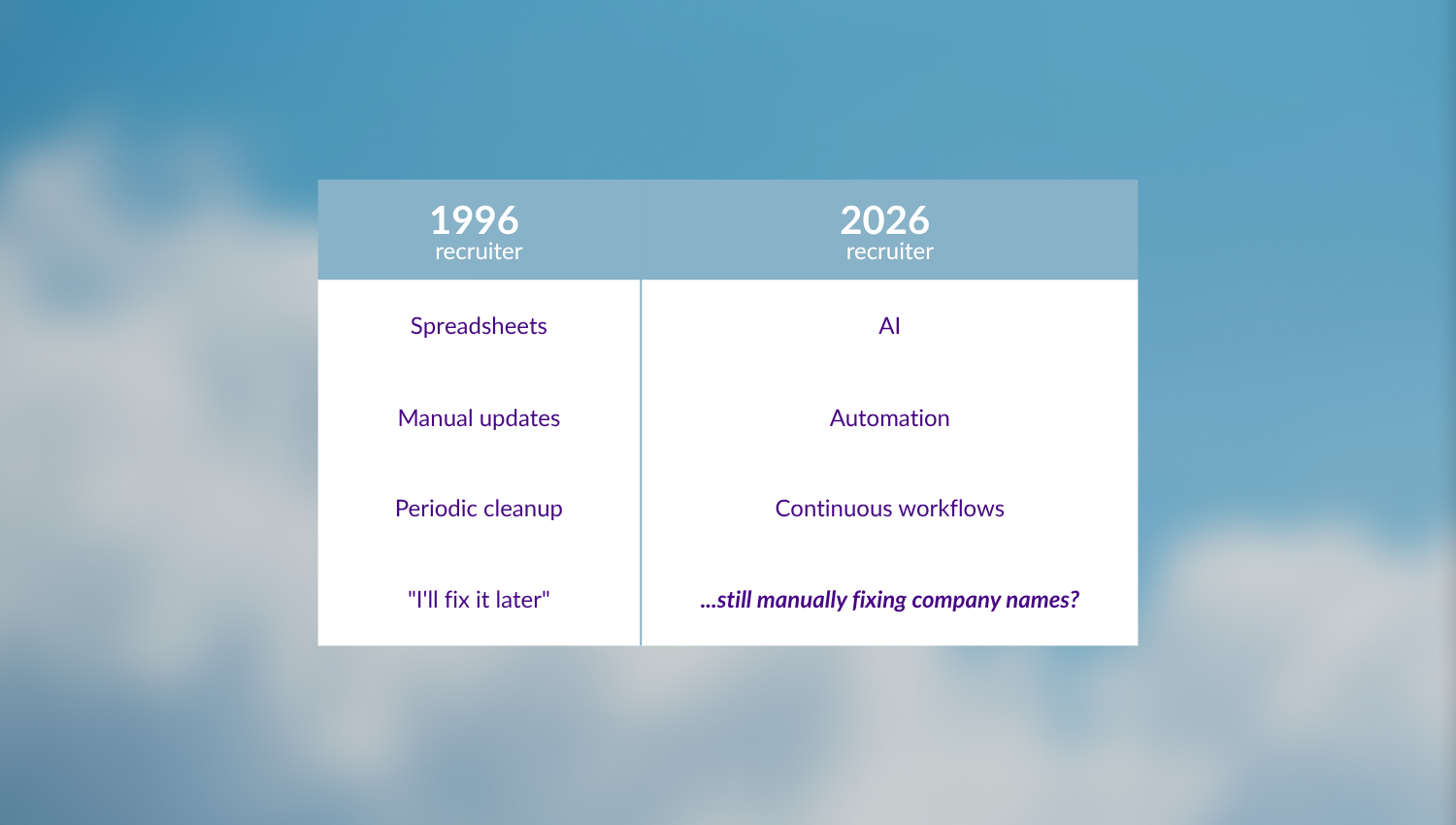
What happens when data cleanup becomes a job instead of a feature?
When data cleanup becomes a job instead of a feature, teams end up spending time fixing the database instead of using it.
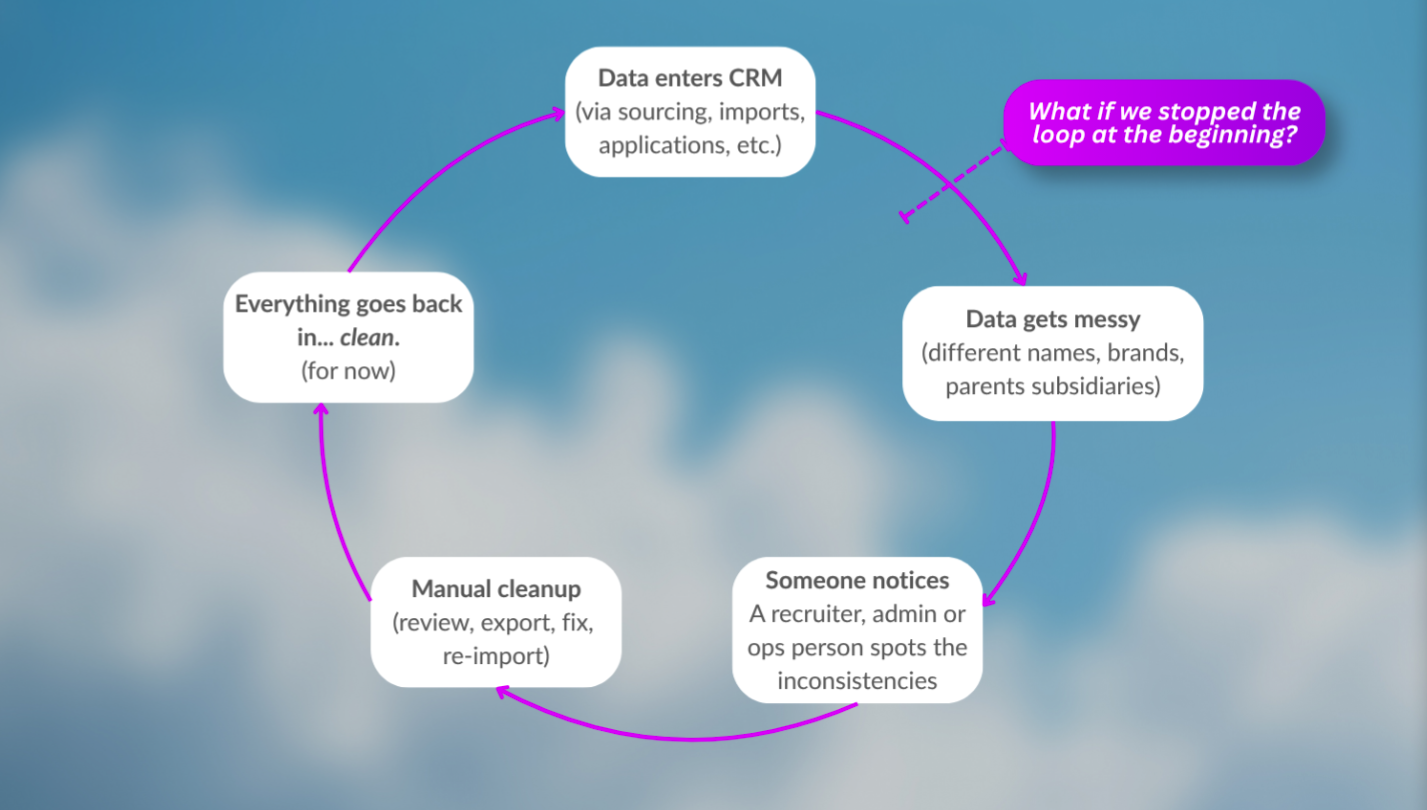
The traditional approach follows a pretty predictable pattern:
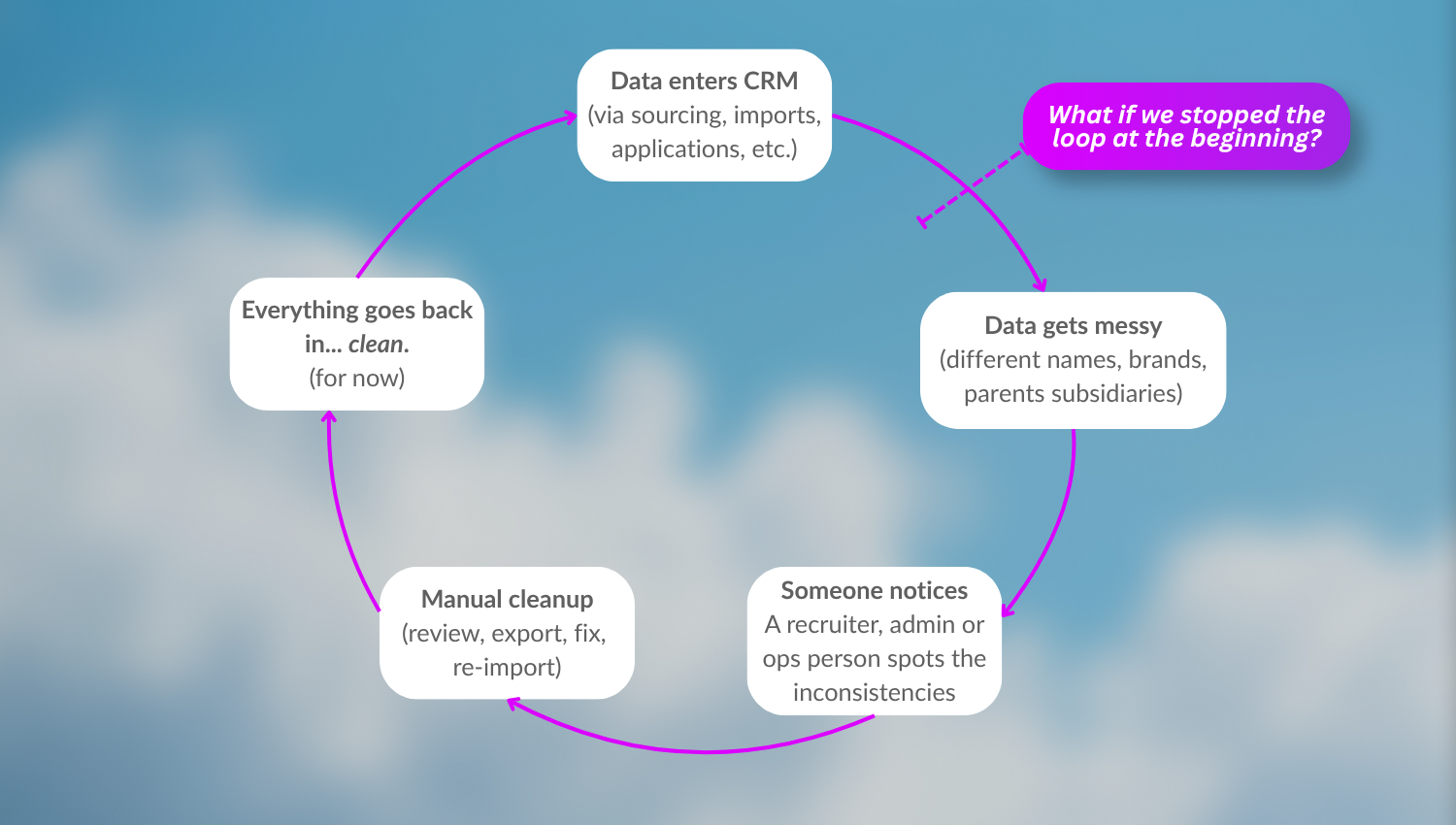
Data gets messy, someone notices, and a recruiter or operations person starts cleaning it up. They review and standardize records, import the cleaned data, and get back to work. Then more data arrives and the cycle starts again.
It's easy to see why this becomes an ungrateful project that never really ends. And the cost isn't just the time teams spend cleaning records.
Poor-quality data can affect the systems built on top of it, too. Gartner identifies inconsistency across data sources as the most challenging data-quality problem, and its research found that poor data quality costs organisations at least $12.9 million a year on average. While that figure comes from 2020 research and isn't specific to recruiting, it shows why preventing inconsistencies in the first place matters.
For recruiting teams, that matters because your database doesn't sit in isolation. It powers the searches you run, the relationships you track, the reports you build and, increasingly, the AI you ask to help you work faster.
→ If you’d like to learn more about how Loxo AI Chat brings the AI assistants you love — Claude, GPT, Gemini, Grok — directly into Loxo, so you can ask questions and get answers grounded in your data plus Loxo's talent graph of 850M+ professionals, click here.
Why does clean data matter even more now?
Clean data matters even more now because modern recruiting technology can only be as useful as the information underneath it.
Recruiting teams ask AI and automation to do more than ever. They want better searches, better matches, smarter recommendations, more useful reporting and faster workflows. But none of that makes inconsistent company information disappear.
Recent research from IBM's Institute for Business Value shows the tension clearly. In its 2025 Chief Data Officer Study, 81% of surveyed CDOs said they were prioritising investments that accelerate AI capabilities, while only 26% felt confident that their data could support new AI-enabled revenue streams. The message is fairly simple: organisations are investing heavily in AI while still grappling with whether their data can support it.
That matters in recruiting because the information underneath your technology shapes what you can actually get from it. If your database doesn't understand that different pieces of company information belong to the same organisation, adding more sophisticated technology on top doesn't solve the underlying problem.
Better technology needs a better foundation.
So what should a modern recruiting database do differently?
A modern recruiting database should recognise the company behind the information, rather than simply storing whatever version a recruiter entered. That's the shift from data cleanup to data understanding.
Imagine your database knows that both P&G and Procter & Gamble refer to the same organisation. It can understand that Dove is a brand associated with Unilever, rather than an unrelated company, and that a subsidiary belongs to a wider corporate family.
That's more useful than simply checking whether two words look similar. Your database needs to understand the real-world organisation behind the record.
And that's where Loxo's company data foundation comes in. The Data Hygiene Agent uses Loxo's company data and talent graph to standardize company information as it enters the platform and connects different versions of the same organisation.
What if data hygiene happened before the mess?
If data hygiene happened before the mess, you’d stop waiting for inconsistencies to pile up to then ask someone to clean them up, so you could get to work.
HubSpot recommends validating CRM data at the point of entry rather than relying on cleanup later. That's where the Data Hygiene Agent changes the approach – it helps standardize company information as it enters Loxo.
The difference looks something like this:
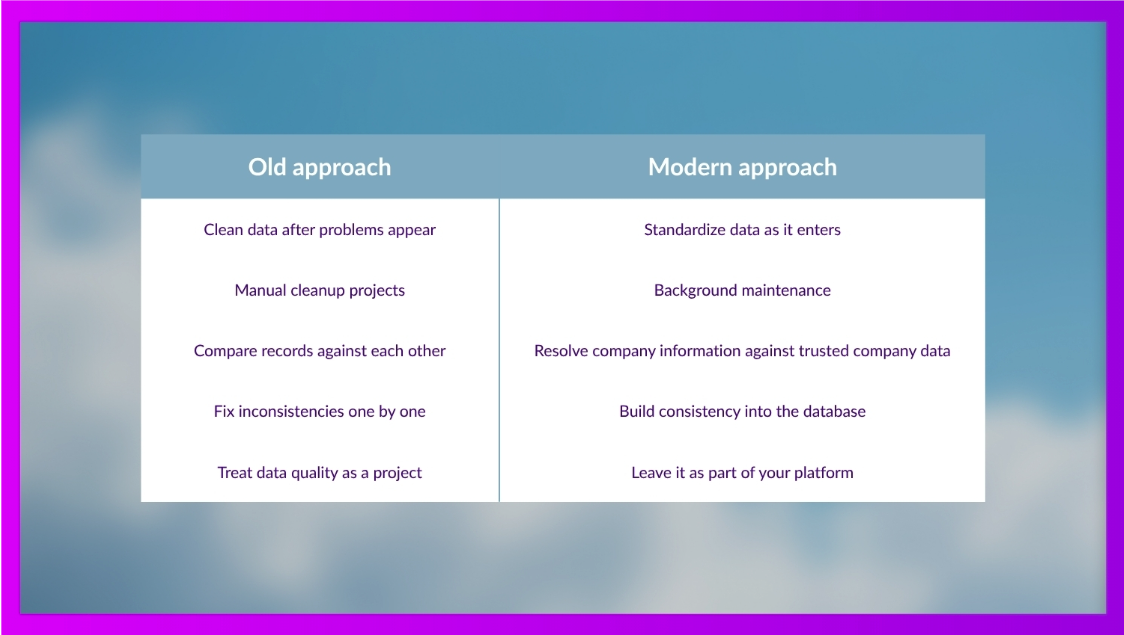
All in all, you’re removing a task for your recruiters.
And because the Data Hygiene Agent doesn't merge or delete records, it doesn't decide which records should exist. It improves the company information inside existing records, while keeping the original value visible, and maintaining a history of what changed and where the information came from.
That distinction matters. Data hygiene isn't about taking control away from recruiters or admins. It's about giving them cleaner data while keeping the visibility and control they need to trust it.
→ If you’d like to know more about how Loxo’s AI Agents can support your work, you can read more here.
Does cleaner company data actually change the recruiter's day?
Yes, cleaner company data changes a recruiter's day by giving them a database they can spend more time using and less time questioning.
The benefit isn't another dashboard to check or another process to learn – it's what happens when the underlying company information stays consistent.
Search becomes easier because company information is standardized and connected. Reporting becomes more reliable because teams have a clearer picture of their company relationships. Recruiters have better context around the organisations they're working with, while the workflows built on top of the database have a stronger data foundation.
Just as importantly, recruiters can see where information came from and what changed. The original company value stays available alongside the standardized information, so important context doesn't disappear.
That matters because recruiting teams already have enough work that only they can do. SHRM's 2025 Recruiting Benchmarking Report highlights how recruiter workloads grow with organisation size, with larger organisations typically assigning more requisitions to each recruiter. The less time recruiters spend maintaining the database, the more time they can spend on the work that actually needs a recruiter.
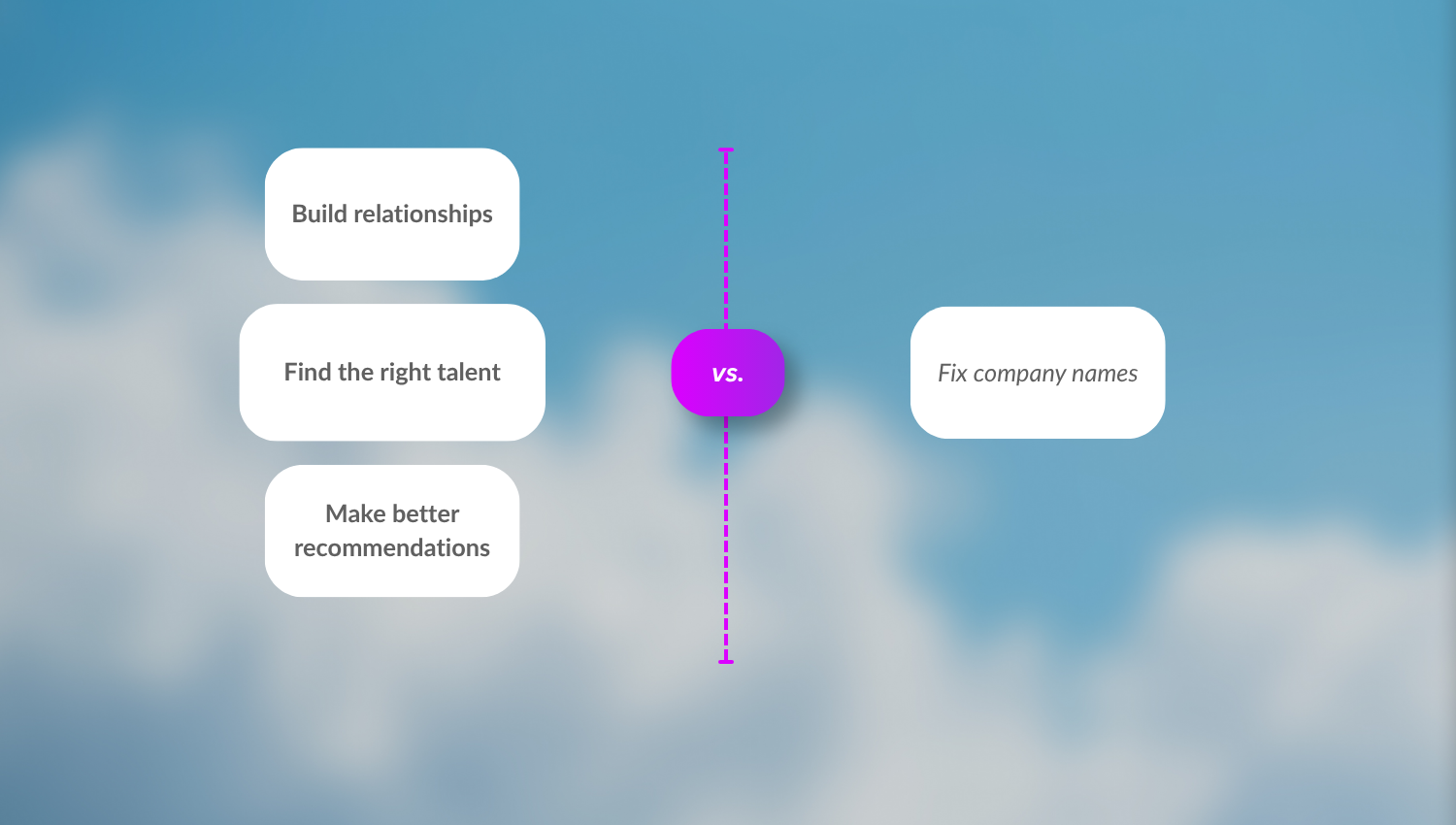
Databases have changed. It’s time our expectations did too.
For years, recruiters have treated “cleaning the database” as one of those unavoidable jobs. They do it before a migration, tackle it on a quiet Friday, or hand it over to Ops when the database gets too messy to ignore.
But recruiting technology has changed. Today, your platform can source, search, match, automate and use AI to help recruiters work faster. So why should the people using all that technology still spend their time manually maintaining the data?
The recruiter in 1996 probably couldn't imagine a database that could understand the companies behind its records, standardize information as it enters the system, and show teams exactly where updates came from. Then again, they probably couldn't imagine having AI write their search strings either.
Recruiters still need to care about their data. They just shouldn't have to spend their time constantly fixing it.
That's the thinking behind the Data Hygiene Agent. It helps Loxo standardize company data as it enters the platform, while keeping the original information visible and giving teams a clear history of each update.
The future of recruiting isn't just about giving recruiters smarter tools. It's about building systems that handle the maintenance, so recruiters can focus on the work that actually needs a recruiter.
Your database has come a long way. Maybe it's time to stop treating it like a spreadsheet.
→ To learn more about Loxo, book a demo here.
<script type="application/ld+json">
{
"@context": "https://schema.org",
"@graph": [
{
"@type": "BlogPosting",
"@id": "https://www.loxo.co/blog/what-if-your-recruiting-database-could-clean-up-after-itself#article",
"headline": "What if Your Recruiting Database Could Clean Up After Itself?",
"description": "Data cleanliness is a constant time-suck for recruiters, but it's critical. Loxo automates database maintenance and standardizes company data, freeing recruiters from manual cleanups to focus on hiring.",
"url": "https://www.loxo.co/blog/what-if-your-recruiting-database-could-clean-up-after-itself",
"mainEntityOfPage": { "@type": "WebPage", "@id": "https://www.loxo.co/blog/what-if-your-recruiting-database-could-clean-up-after-itself" },
"datePublished": "[PUBLISH-DATE]",
"dateModified": "[MODIFIED-DATE]",
"inLanguage": "en-US",
"author": { "@type": "Organization", "name": "Loxo", "url": "https://www.loxo.co" },
"publisher": {
"@type": "Organization",
"name": "Loxo",
"url": "https://www.loxo.co",
"logo": { "@type": "ImageObject", "url": "https://cdn.prod.website-files.com/663b70d752cc952b743d3b67/66bd257bbdba631be076b2e4_loxo-logo.svg" }
},
"image": { "@type": "ImageObject", "url": "https://cdn.prod.website-files.com/665f887083756c794a9927dd/6ac40a56e9d70f6e5fb9a586_data%20hygiene.png" },
"articleSection": "ATS/CRM",
"keywords": "recruiting database, data hygiene, CRM data quality, company data standardization, recruiting CRM, AI agents for recruiting",
"about": [
{ "@type": "Thing", "name": "Data hygiene" },
{ "@type": "Thing", "name": "Data quality" },
{ "@type": "Thing", "name": "Customer relationship management" },
{ "@type": "Thing", "name": "Recruitment" }
],
"mentions": [
{
"@type": "SoftwareApplication",
"name": "Loxo Data Hygiene Agent",
"applicationCategory": "BusinessApplication",
"url": "https://www.loxo.co/ai-agents/data-agents"
},
{
"@type": "SoftwareApplication",
"name": "Loxo AI Chat",
"applicationCategory": "BusinessApplication",
"url": "https://www.loxo.co/products/loxo-ai-chat"
}
],
"citation": [
{ "@type": "CreativeWork", "name": "HubSpot: How to keep CRM customer data up to date", "url": "https://blog.hubspot.com/marketing/keep-customer-data-up-to-date-everywhere" },
{ "@type": "CreativeWork", "name": "Gartner: Data Quality", "url": "https://www.gartner.com/en/data-analytics/topics/data-quality" },
{ "@type": "CreativeWork", "name": "IBM Institute for Business Value: 2025 Chief Data Officer Study", "url": "https://www.ibm.com/thought-leadership/institute-business-value/en-us/report/2025-cdo" },
{ "@type": "CreativeWork", "name": "SHRM 2025 Recruiting Benchmarking Report", "url": "https://www.shrm.org/content/dam/en/shrm/research/2025-recruiting-benchmarking-report.pdf" }
]
},
{
"@type": "DefinedTerm",
"@id": "https://www.loxo.co/blog/what-if-your-recruiting-database-could-clean-up-after-itself#datahygiene",
"name": "Data hygiene",
"description": "In a recruiting database, data hygiene is keeping company information consistent and connected — recognizing that variations like P&G and Procter & Gamble, or a brand and its parent company, refer to the same real-world organization. Modern data hygiene standardizes information as it enters the system rather than relying on periodic manual cleanups.",
"inDefinedTermSet": { "@type": "DefinedTermSet", "name": "Loxo Recruiting Glossary", "url": "https://www.loxo.co" }
},
{
"@type": "FAQPage",
"@id": "https://www.loxo.co/blog/what-if-your-recruiting-database-could-clean-up-after-itself#faq",
"mainEntity": [
{
"@type": "Question",
"name": "Why are recruiters still responsible for keeping company data clean?",
"acceptedAnswer": { "@type": "Answer", "text": "Recruiters are still responsible for keeping company data clean because database maintenance has traditionally required teams to find, review and fix inconsistent information themselves. Company data enters from sourcing, applications, imports, integrations, browser extensions and manual entry, and each source can represent the same organization slightly differently." }
},
{
"@type": "Question",
"name": "What happens when data cleanup becomes a job instead of a feature?",
"acceptedAnswer": { "@type": "Answer", "text": "When data cleanup becomes a job instead of a feature, teams end up spending time fixing the database instead of using it. Data gets messy, someone cleans it up, new data arrives, and the cycle starts again — while search, reporting and AI built on top of that data become less reliable." }
},
{
"@type": "Question",
"name": "Why does clean data matter even more now?",
"acceptedAnswer": { "@type": "Answer", "text": "Clean data matters even more now because modern recruiting technology can only be as useful as the information underneath it. Better searches, matches, recommendations, reporting and AI all depend on a database that understands which pieces of company information belong to the same organization." }
},
{
"@type": "Question",
"name": "What should a modern recruiting database do differently?",
"acceptedAnswer": { "@type": "Answer", "text": "A modern recruiting database should recognize the company behind the information, rather than simply storing whatever version a recruiter entered. That is the shift from data cleanup to data understanding — for example, knowing that P&G and Procter & Gamble are the same organization and that a subsidiary belongs to a wider corporate family." }
},
{
"@type": "Question",
"name": "Does cleaner company data actually change the recruiter's day?",
"acceptedAnswer": { "@type": "Answer", "text": "Yes. Cleaner company data gives recruiters a database they can spend more time using and less time questioning. Search becomes easier, reporting becomes more reliable, and recruiters get better context on the organizations they work with." }
}
]
}
]
}
</script>